
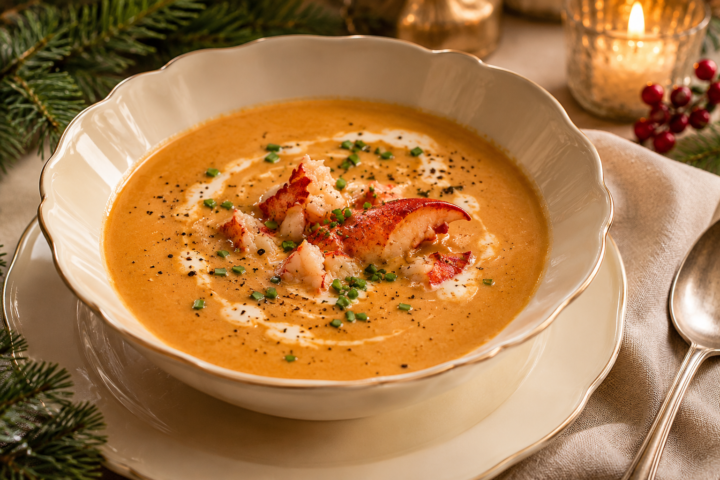
This creamy Christmas lobster bisque brings restaurant-style warmth to a holiday table without requiring complicated plating. The soup is silky, deeply savory, and finished with tender lobster, cream, tomato, gentle herbs, and a small squeeze of lemon. Serve it in modest portions as an elegant first course, or pair larger bowls with bread and a crisp salad for a relaxed Christmas Eve supper.

The method uses good seafood stock and cooked lobster meat, so it is realistic for a home kitchen during a busy season. Aromatic vegetables, tomato paste, and a brief flour-based thickening step build the body. Blending the base before adding cream gives the bisque its characteristic smooth texture while protecting the lobster from overcooking.
Why lobster bisque works for Christmas
Lobster feels celebratory, but bisque stretches a smaller quantity across several servings. That makes it useful when you want one luxurious element without building the entire meal around a large seafood purchase. It can also be prepared mostly in advance: make and blend the soup base earlier, then reheat gently and add the cream and lobster shortly before serving.
The warm coral color looks festive without relying on artificial garnishes. A restrained finish of lobster pieces, chives, cream, and cracked pepper is enough.
Choosing lobster and seafood stock
Cooked lobster meat
Use cooked claw, knuckle, or tail meat, or a mixture. Claw and knuckle meat is especially tender and often less expensive than using only tails. If starting with frozen cooked meat, thaw it overnight in the refrigerator, drain it well, and keep it chilled until the final minutes of cooking.
Check the lobster carefully for small shell fragments before cutting it into bite-size pieces. Reserve several attractive pieces for garnishing the bowls.
Seafood stock
The stock supplies much of the bisque’s character, so choose one that tastes clean rather than aggressively salty. Lobster stock is ideal, but a mild fish or seafood stock works. Low-sodium stock gives you more control. If the stock tastes strong on its own, replace up to one cup with water.
Key flavor-building ingredients
Shallot, carrot, and celery create a sweet aromatic base. Chop them small so they soften quickly and blend smoothly.
Tomato paste gives color, acidity, and savory depth. Cook it for a minute or two until it darkens slightly; adding liquid immediately leaves its flavor raw.
Dry sherry is optional but traditional in many bisques. It adds nutty complexity. Use cooking alcohol only if appropriate for your household; an equal amount of extra stock is a simple substitute.
Heavy cream rounds out the tomato and seafood flavors. Add it after blending and avoid a hard boil, which can make the dairy separate.
Lemon should be subtle. One or two teaspoons at the end brightens the soup without turning it into lemon soup.
How to get a smooth, luxurious texture
- Soften the vegetables fully. The carrot should be tender before the soup is blended.
- Cook the flour briefly. One minute removes its raw flavor while preserving its thickening power.
- Simmer gently. Rapid boiling reduces the stock too quickly and can make the final soup overly salty.
- Blend before adding lobster. Never blend the lobster meat into the base; keep its texture and add it near the end.
- Strain only if desired. A powerful blender produces a smooth home-style bisque. Passing it through a fine-mesh strainer makes it more refined but removes some body.
Make-ahead Christmas plan
Prepare the recipe through the blending step up to two days ahead. Cool the base promptly in shallow containers, cover, and refrigerate. Keep the lobster meat in a separate airtight container.
On Christmas Day, warm the base slowly over medium-low heat. Stir in the cream, then add the lobster just long enough to heat through. This approach keeps the meat tender and leaves only a saucepan, ladle, and serving bowls to manage close to dinner.
Serving ideas
For a first course, serve about three-quarters of a cup per person in warmed bowls. For a light main course, allow roughly one and a half cups and add toasted baguette, garlic bread, or a simple green salad. Small puff-pastry twists also suit the silky soup.
This bisque fits naturally before Salmon Wellington or alongside a selection from the Feast of the Seven Fishes menu. For more choices, link back to the established Christmas seafood recipes collection.
Easy substitutions
Without sherry: Use the same amount of seafood stock and add an extra half teaspoon of lemon juice at the end.
Lighter finish: Half-and-half may replace heavy cream, but keep the heat low and do not boil after adding it.
Gluten-free option: Use a measure-for-measure gluten-free flour blend, or omit the flour and blend in one small cooked potato for body.
Different shellfish: A mixture of lobster and crab can work, but the result should be described as seafood bisque rather than pure lobster bisque.
Creamy Christmas Lobster Bisque Recipe
Creamy Christmas Lobster Bisque
A silky holiday lobster bisque with tomato, herbs, seafood stock, cream, and tender lobster pieces.
Prep: | Cook: | Total: | Serves: 6 first-course servings
Ingredients
- 1 pound cooked lobster meat, checked for shells and divided
- 3 tablespoons unsalted butter
- 1 medium shallot, finely chopped
- 1 small carrot, finely chopped
- 1 celery stalk, finely chopped
- 3 garlic cloves, minced
- 3 tablespoons tomato paste
- 3 tablespoons all-purpose flour
- 1/3 cup dry sherry, or additional seafood stock
- 4 cups low-sodium seafood or lobster stock
- 1 bay leaf
- 1/2 teaspoon dried thyme
- 1/2 teaspoon sweet paprika
- 1/4 teaspoon black pepper
- 1 cup heavy cream
- 1 to 2 teaspoons fresh lemon juice
- Kosher salt, to taste
- Chopped chives and a little cream, for garnish
Instructions
- Set aside about one-quarter of the lobster meat for garnish. Cut the remainder into bite-size pieces and refrigerate while making the soup.
- Melt the butter in a heavy pot over medium heat. Add the shallot, carrot, and celery. Cook for 7 to 9 minutes, stirring occasionally, until very soft. Add the garlic and cook for 30 seconds.
- Stir in the tomato paste and cook for 2 minutes. Sprinkle in the flour and cook, stirring, for 1 minute.
- Slowly add the sherry, whisking to loosen any browned bits. Gradually whisk in the seafood stock. Add the bay leaf, thyme, paprika, and black pepper.
- Bring to a gentle simmer. Cook partially covered for 20 minutes, stirring occasionally, until the vegetables are tender and the soup is lightly thickened.
- Remove the bay leaf. Blend the soup carefully with an immersion blender until smooth, or blend in batches in a countertop blender, allowing steam to escape safely. Strain through a fine-mesh sieve if an extra-smooth texture is desired.
- Return the soup to low heat. Stir in the cream and lobster pieces. Warm gently for 3 to 5 minutes without boiling, until the lobster is hot.
- Add 1 teaspoon lemon juice and taste. Add more lemon and salt only as needed. Ladle into warm bowls and garnish with reserved lobster, chives, cream, and black pepper.
Food-safety note: Keep cooked lobster refrigerated until needed. Heat the finished bisque gently to at least 165°F when reheating leftovers, and do not leave it at room temperature for more than two hours.
Storage and reheating
Transfer leftover bisque to shallow containers and refrigerate within two hours. Use within two days. Reheat over low heat, stirring frequently, until it reaches 165°F. Avoid boiling because the cream may separate and the lobster may become tough.
Freezing finished cream-based bisque is not ideal. For better results, freeze the blended base before adding cream and lobster for up to one month. Thaw it overnight in the refrigerator, heat it thoroughly, then finish with fresh cream and lobster.
Troubleshooting
Why is my bisque too thick?
Whisk in warm seafood stock a few tablespoons at a time until it reaches a pourable consistency. Remember that the soup continues to thicken as it cools.
Why does the soup taste flat?
It may need salt, acidity, or both. Add salt in small pinches, then try another half teaspoon of lemon juice. The goal is to sharpen the seafood flavor, not make the soup noticeably sour.
Why did the cream look grainy?
The heat was probably too high after the cream was added. Keep the finished soup below a boil and reheat it gently.
Can I use raw lobster?
This recipe is timed for cooked lobster. If using raw lobster, cook it safely first using a reliable method, cool it enough to handle, remove the meat, and then proceed with the recipe.