
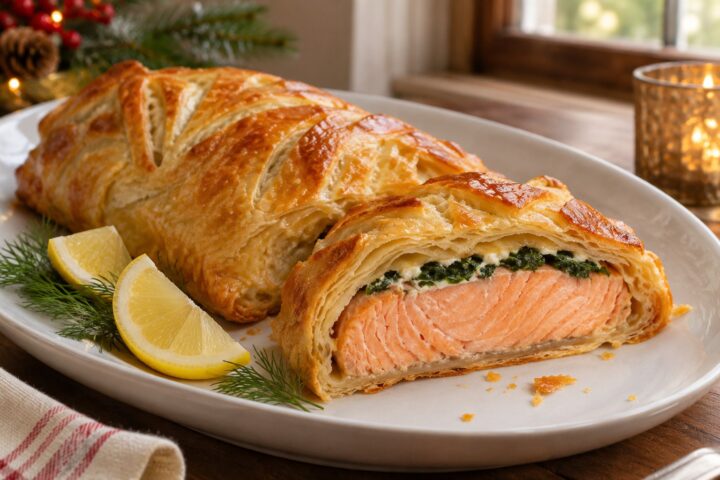
Salmon Wellington turns a familiar salmon fillet into a holiday centerpiece: golden puff pastry outside, tender fish inside, and a thin layer of spinach and cream cheese between them. The filling is flavored with lemon zest, garlic and dill, so it tastes fresh alongside the buttery pastry.
This recipe makes one parcel for four people. It is a good Christmas dinner choice when you want a main course that arrives at the table ready to slice. The most important preparation happens before assembly: squeeze the spinach dry, cool the filling completely, and keep the pastry cold.
Jump to the recipe · Make-ahead and storage
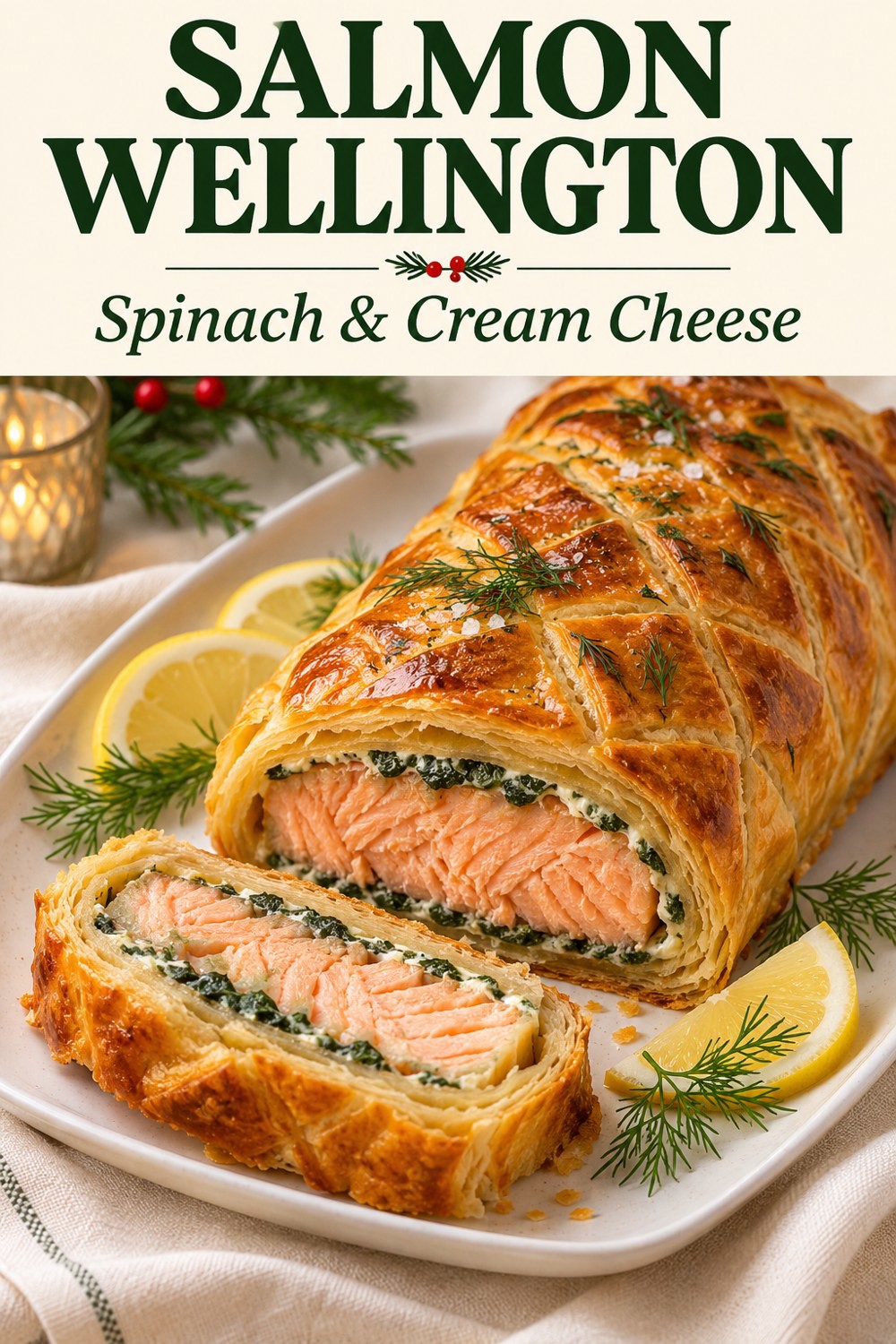
What makes this different from other Christmas salmon dishes?
A glazed salmon fillet is all about its sauce. Here, the pastry is part of the meal. You get crisp edges, a creamy vegetable layer and substantial slices that need only a green side dish. Unlike mushroom Wellington, this version uses fish as its center and a restrained amount of filling so the pastry can bake properly.
For another preparation, see our cranberry orange glazed salmon. Choose one salmon main for your dinner; there is no need to serve several rich fish dishes together.
Choose the salmon and pastry carefully
Ask for a skinless, boneless center-cut salmon fillet, about 1¼ pounds (565 g), approximately 8 by 4 inches and around 1 inch thick. An evenly thick piece cooks more consistently than a thin tail section. Run clean fingers gently over the surface to check for pin bones and remove any with fish tweezers.
Use two sheets of ready-made puff pastry, about 17.3 ounces (490 g) in total. Brands differ in sheet dimensions. Roll each sheet just enough to leave approximately 1½ inches around the fish; avoid rolling so thin that you lose the visible layers. Thaw according to the package directions and refrigerate until you are ready to assemble.
Frozen chopped spinach is convenient because you can squeeze it thoroughly. Measure the 5 ounces before squeezing. If using fresh spinach, start with about 8 ounces (225 g), wilt it in a pan, cool, squeeze and chop. The final cooked quantity varies, so aim for a compact layer rather than a mound.
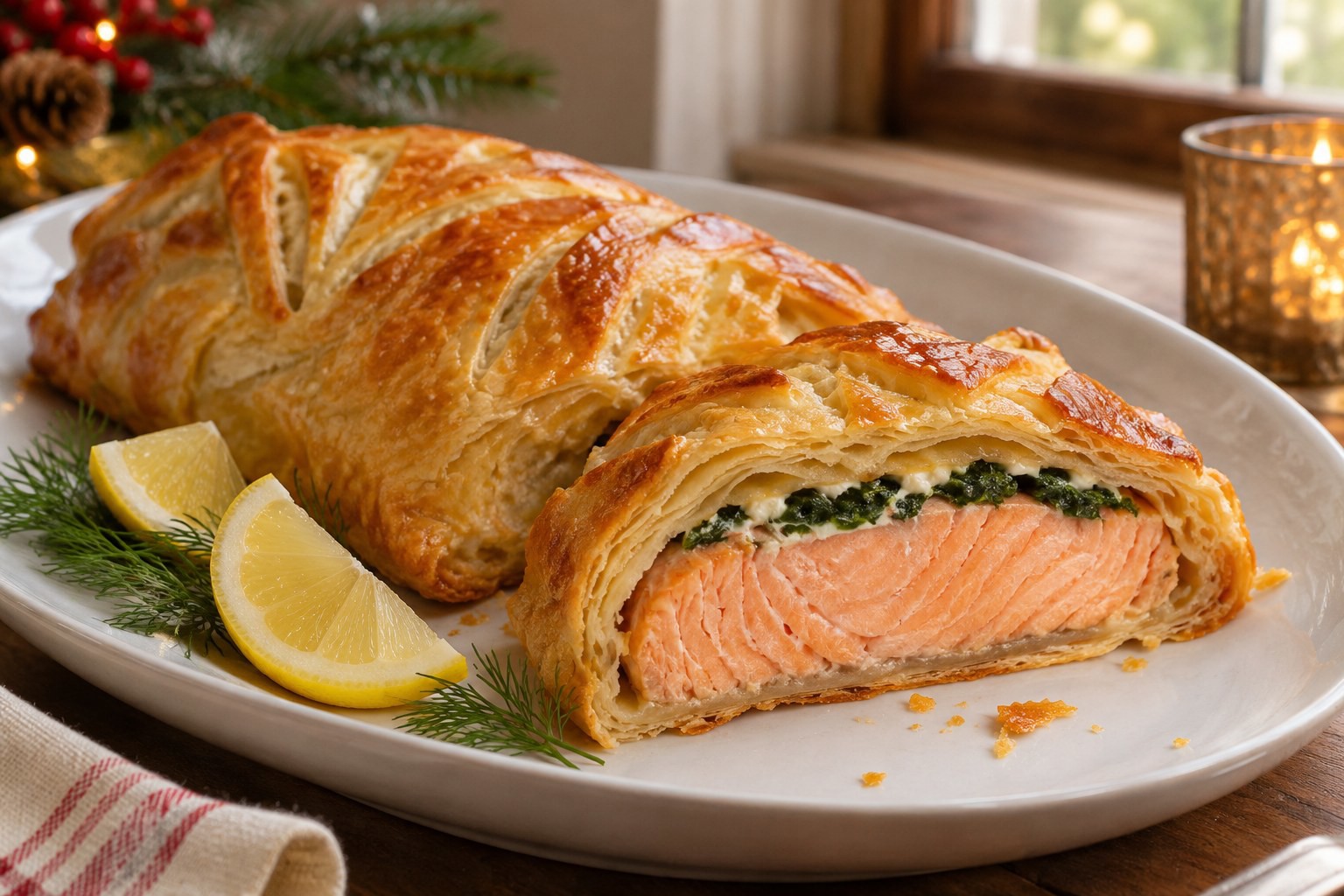
Salmon Wellington with Spinach and Cream Cheese
Yield: 4 servings · Prep: 25 minutes · Chill: 20 minutes · Bake: 30–40 minutes · Rest: 5 minutes · Total: about 1 hour 30 minutes, plus pastry thawing
Ingredients
- 1¼ pounds (565 g) skinless, boneless center-cut salmon, about 1 inch thick
- 2 sheets puff pastry, about 17.3 ounces (490 g), thawed but cold
- 5 ounces (140 g) frozen chopped spinach, thawed and squeezed very dry
- 4 ounces (115 g) full-fat cream cheese, softened
- 1 tablespoon unsalted butter
- 1 small shallot, finely chopped, about ¼ cup
- 2 garlic cloves, minced
- 1 teaspoon finely grated lemon zest
- 1 tablespoon chopped fresh dill, or 1 teaspoon dried dill
- 1 teaspoon Dijon mustard
- ½ teaspoon fine salt, divided, plus more to taste
- ¼ teaspoon ground black pepper
- 1 large egg beaten with 1 teaspoon water, for brushing
- 1 tablespoon all-purpose flour, for the work surface
- Lemon wedges, to serve
Instructions
- Prepare the filling. Melt butter in a skillet over medium heat. Add shallot and cook 3–4 minutes until soft. Add garlic and cook 30 seconds. Stir in the squeezed spinach and cook 1–2 minutes to remove remaining moisture. Spread on a plate and cool completely.
- Mix and chill. Combine the cold spinach mixture with cream cheese, lemon zest, dill, Dijon and ¼ teaspoon salt. Refrigerate while you prepare the pastry. Do not put warm filling on puff pastry.
- Prepare the oven and fish. Heat a conventional oven to 400°F (200°C). Line a metal baking sheet with parchment. Pat salmon dry and season with the remaining ¼ teaspoon salt and the pepper.
- Build the parcel. On a lightly floured surface, roll one pastry sheet into a rectangle large enough for the fish plus a 1½-inch border. Transfer to the prepared tray. Set salmon in the center and spread the spinach mixture evenly over its top, leaving the sides of the fish exposed.
- Seal. Roll the second sheet slightly larger so it can drape over the filling. Brush the lower pastry border lightly with egg wash, cover with the second sheet, and press the edges firmly together. Trim excess pastry to leave a ¾-inch seam and crimp with a fork. Avoid a thick folded rim.
- Chill and vent. Refrigerate the assembled parcel for 20 minutes. Brush the top with egg wash, avoiding the cut edges. Cut three small steam vents through the top pastry. Any decorative scoring should be shallow.
- Bake. Bake on the lower-middle rack for about 30–40 minutes, until the pastry is deeply golden, including its edges, and the thickest part of the fish reaches 145°F (63°C). Insert a clean instant-read thermometer through a vent into the fish. If the top browns early, tent loosely with foil and continue cooking. Thickness and pastry brand can change the time.
- Slice. Rest 5 minutes, then cut into four portions with a serrated knife. Serve immediately with lemon wedges. The pastry is crispest straight from the oven.
Common problems and how to avoid them
Why is the bottom pastry soggy?
Wet spinach, damp fish and warm filling all release moisture into the dough. Squeeze spinach in a clean towel, pat the salmon dry, and cool the cooked vegetables fully. Use a metal baking sheet rather than a deep casserole dish, and keep the border neatly sealed without several thick folds.
Why did the pastry split?
Pastry stretched tightly over a large mound of filling can tear as it expands. Roll the upper sheet large enough to drape over the fish, leave small vents for steam, and avoid overfilling. If a small hole appears before baking, patch it with a thin scrap and a little egg wash.
What if the pastry is golden before the salmon is cooked?
Protect the top loosely with foil and continue baking, checking the temperature. Do not judge doneness only by the pastry color. For the next batch, choose a more even fillet and check that the oven is fully preheated. Our temperature guidance follows the FoodSafety.gov cooking chart.
Substitutions that keep the recipe practical
Use parsley instead of dill for a milder finish. Replace shallot with the same amount of finely chopped onion and cook until fully softened. You may omit Dijon if needed; check condiment labels for allergens. A different fish needs its own cooking assessment, so this timing is written for salmon.
For a dairy-free variation, both the cream cheese and pastry must be suitable: some puff pastry contains butter. Plant-based cream cheeses vary in moisture and may soften the base. Gluten-free pastry also behaves differently; follow its handling and baking directions rather than assuming identical results.
Make-ahead, storage and reheating
Make the spinach filling up to one day ahead and refrigerate it covered. Assemble the parcel close to baking, keeping the fish chilled. For the best pastry texture, avoid leaving the fully assembled raw parcel overnight; moisture can migrate into the base. The 20-minute chilling step is included in the recipe time.
Refrigerate leftovers in shallow covered containers within 2 hours, or within 1 hour if the temperature is above 90°F (32°C). Use within 2 days for best quality. Reheat individual portions in a 350°F (175°C) oven until their centers reach 165°F (74°C); tent the top if it darkens. A microwave softens the pastry. Freezing the baked parcel is not recommended for the best texture.
What to serve with salmon Wellington
The pastry already supplies a substantial starch, so start with green beans, roasted broccoli, asparagus or a lemon-dressed salad. For four people, one main, one vegetable and a simple dessert makes a manageable holiday meal.
For a larger Christmas Eve menu, use our beginner-friendly Feast of the Seven Fishes plan as a planning guide. That meal is a family and cultural tradition, not a requirement to cook seven fish dishes.
Frequently asked questions
Can I use frozen salmon?
Yes. Thaw it in the refrigerator, remove any packaging as directed by the manufacturer, and dry it thoroughly. Do not wrap a frozen fillet in the pastry; the exterior could brown while the center remains undercooked.
Do I have to use an entire side of salmon?
No. This recipe is designed around a smaller center-cut piece. A much larger side needs more pastry, a larger tray and a different baking time. For a crowd, prepare two parcels of the stated size and leave room between them.
Can I skip the cream cheese?
It binds the chopped filling and keeps it spreadable. Omitting it changes the recipe; for a simpler dinner without cream cheese, choose a baked salmon preparation instead.